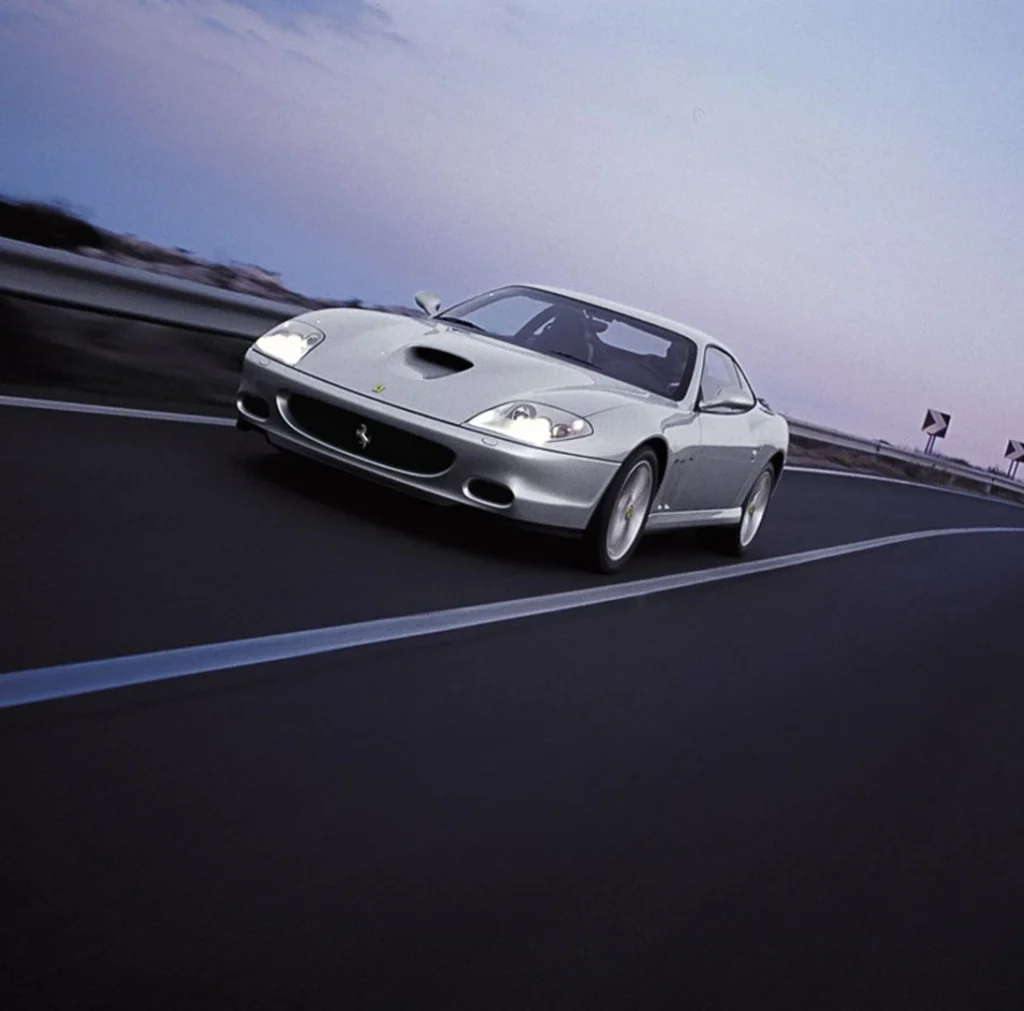

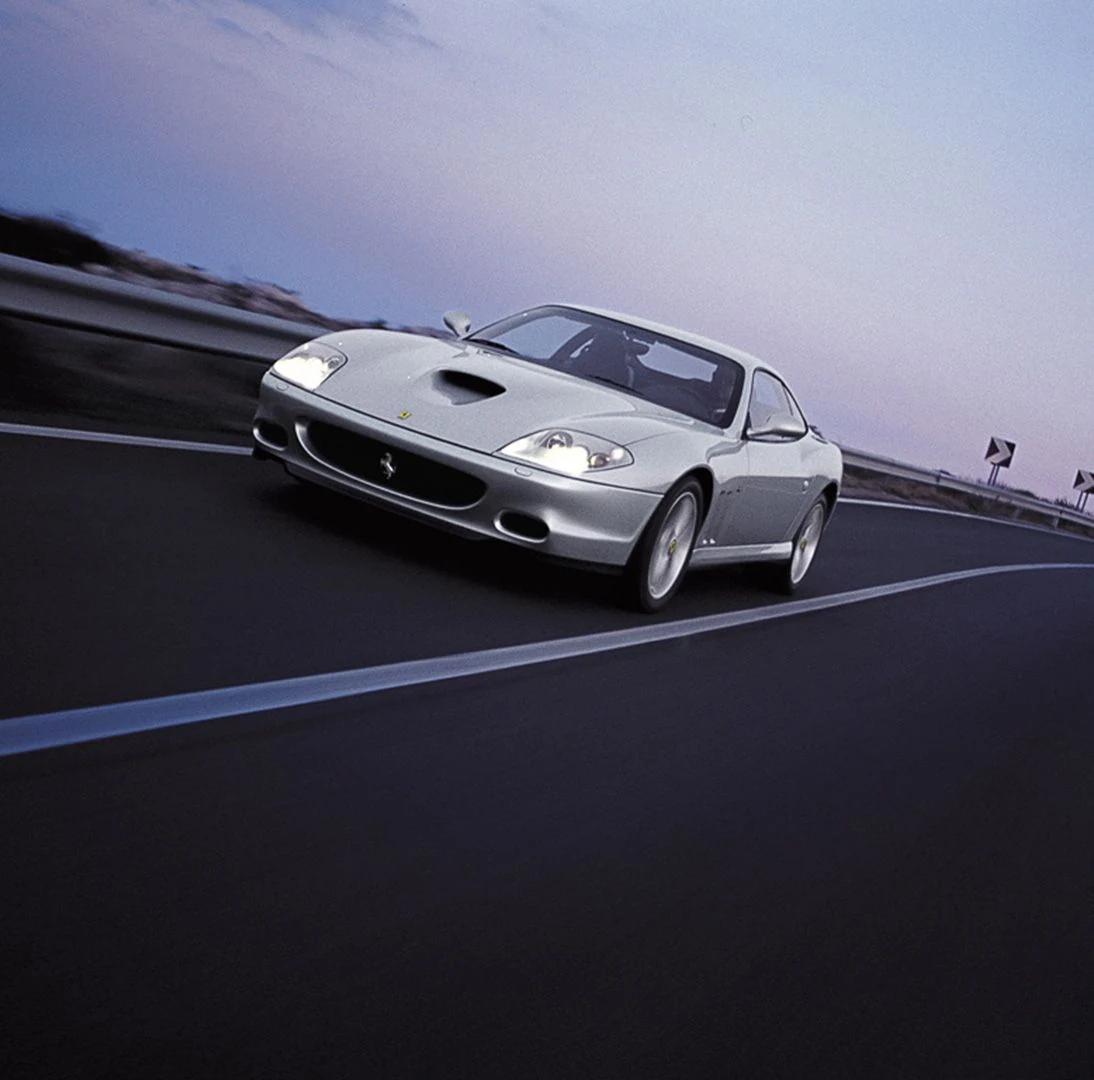
When compared to the 1980s poster car stars that were the Testarossa and its wedgy successors, the Ferrari 550 and 575 M Maranello looked downright sensible, like swapping spandex for a tailored suit. Even Ferrari described the looks as “beautifully sober”.
Soon after his arrival back at Ferrari as President in 1991, Luca di Montezemolo decreed that the brand’s V12 flagship coupe should revert to a front-engined layout for the first time since the iconic 365 GTB/4 ‘Daytona’ almost two decades earlier.
It was a bold move, as the show-stopping Testarossa had become a phenomenon, with celebrity owners like Rod Stewart, Elton John and Michael Jordan and appearances in landmark media such as the Miami Vice TV series and Out Run video game.
In terms of the driving experience, however, little actually changed. For all its outlandish styling, road tests then and now praised the Testarossa for its ride quality, refinement and smooth, long-legged performance. It was the consummate grand tourer, a baton which the 550 Maranello was only too happy to pick up, albeit with the engine now located in front of the driver.
Ferrari really hit the nail on the head with the 550 and it’s rightly regarded as a modern classic. So right, in fact, that at first (and indeed second) glance the 575 M seems to be essentially identical.
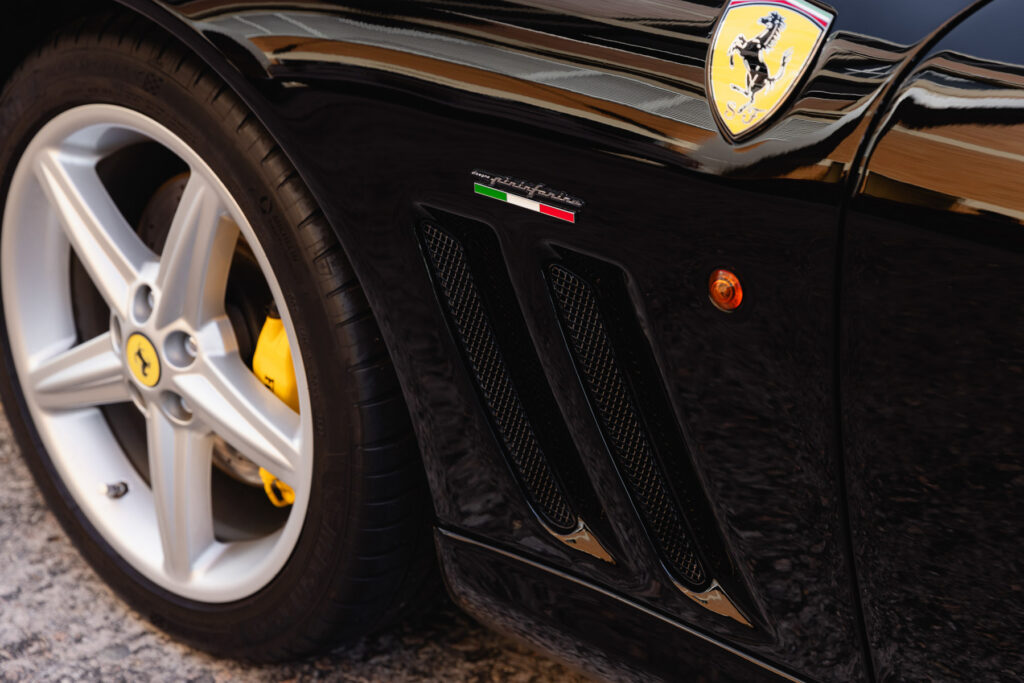
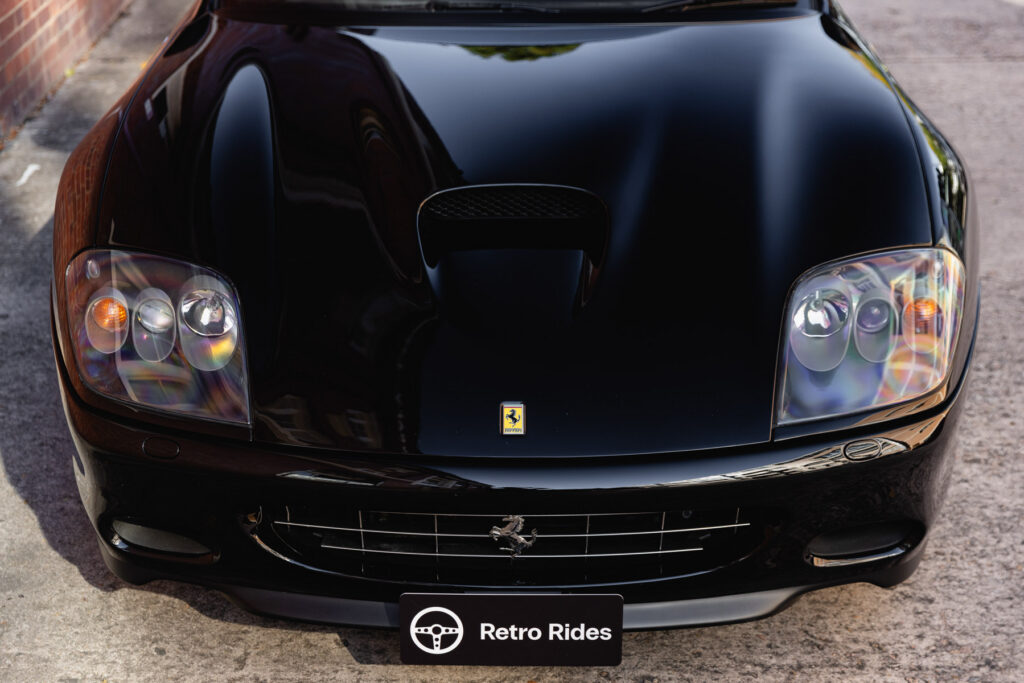
Pininfarina certainly didn’t go overboard with the exterior changes, with body-coloured surrounds for the now-xenon headlights the easiest way to differentiate the two models, along with larger front air intakes for better brake cooling and a revised front spoiler for improved aerodynamics.
Beneath the skin is where you’ll find the changes that earned the 575 its ‘M’ designation, which stands for modificata, a term frequently used by Ferrari to denote a major mid-life facelift.
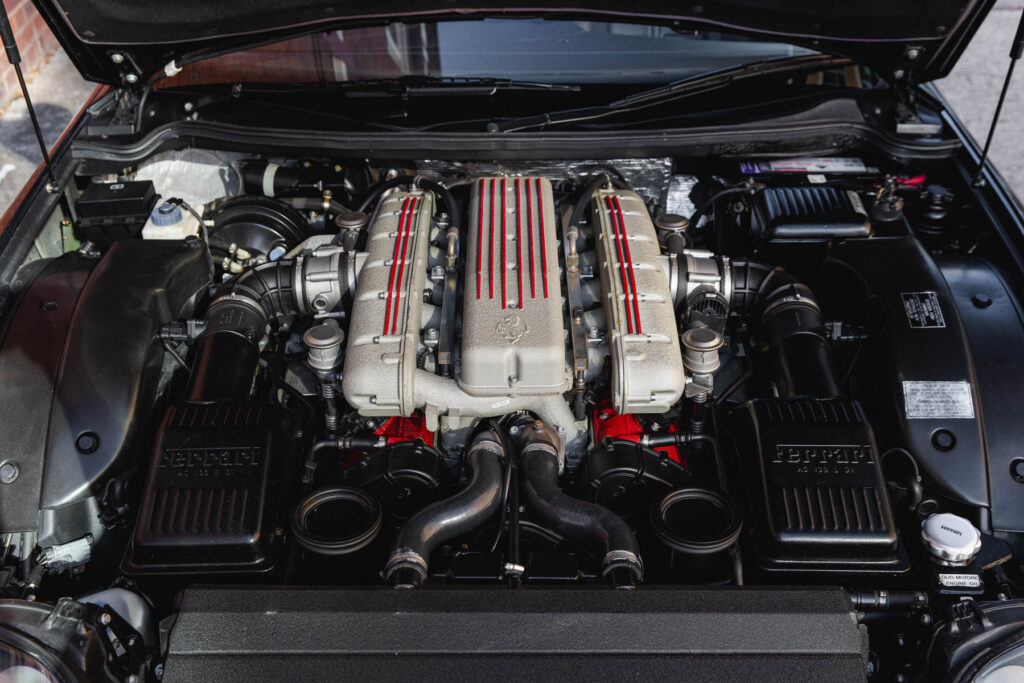
As the name suggests, the 5.5-litre V12 550 became the 5.75-litre 575, a 1mm bore and 2mm stroke increase enlarging capacity from 5474cc to 5748cc. Combined with a lift in compression from 10.8 to 11.0:1, outputs improved from the 550’s 357kW at 7000rpm and 569Nm to 379kW at 7250rpm and 588Nm at 5250rpm for the 575. It wasn’t just more peak power, either, as torque improved by 15Nm from 1000-4000rpm.
It was what that engine was connected to that garnered the most headlines, though. The 575 M launched smack-bang in the middle of Ferrari’s period of F1 dominance and the technology it was debuting on the racetrack was beginning to trickle into its road cars.
By this time, the F1 shift semi-automated manual was well-established, having first been introduced on the 355 F1 in 1997, but the 575 was the first time it had been attached to a 12-cylinder engine.
Combined with the extra power, it cut the 0-100km/h time to 4.2sec (-0.2sec compared to the 550), the 0-400m time to 12.25sec (-0.25sec) and the 0-1000m time to 21.9sec (-0.6sec). The vast majority of buyers ticked the F1 box. Of the 2064 575s built, just 246 were manual.
Pininfarina went further on the inside, updating the interior with a new dash, centre console and instruments, in addition to revised switchgear and new technology like a digital fuel gauge for the 105-litre tank, with satellite navigation becoming an option. Buyers also had the opportunity to add their own personal touch through an expanded Carrozzeria Scaglietti Personalisation Program.
The chassis fundamentals remained the same, but almost every area underwent modifications. The dampers advanced from a two-stage system to being continually adjustable, constantly monitoring damping force and ride height to adapt to road conditions.
Front tyre width increased 30mm to 255/40 with the rears remaining 295/35, weight distribution became a perfect 50:50 and the ABS/ASR sensors were incorporated into the wheels, saving 1.8kg per front wheel and 1.2kg per rear wheel.
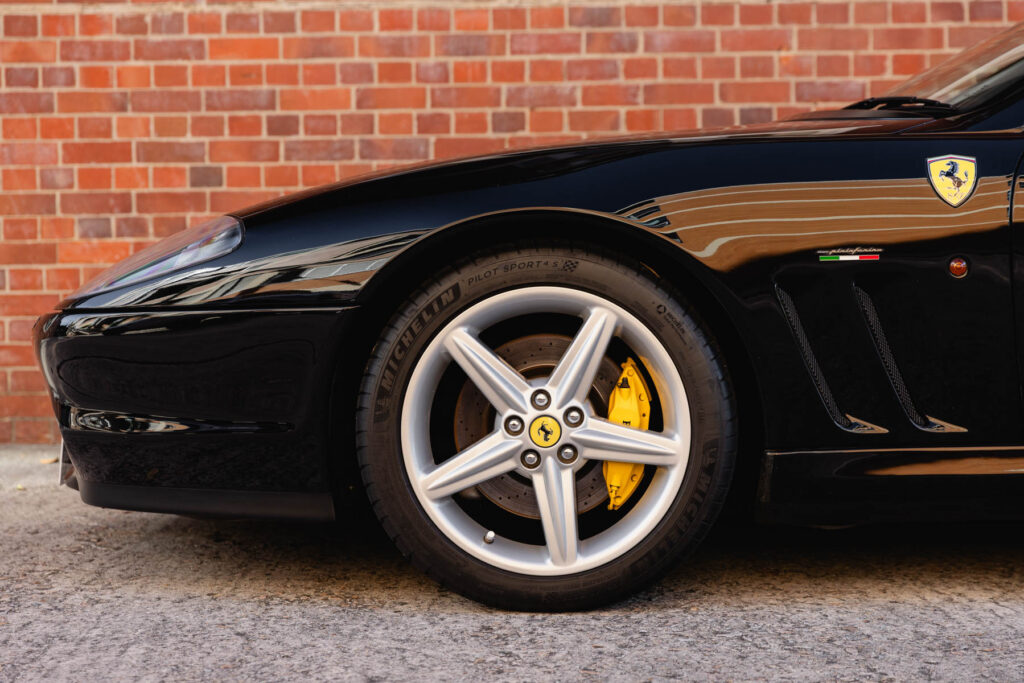
The brakes remained 330mm front discs and 310mm rears with four-piston calipers at both ends but the discs were now cross-drilled and ventilated, in addition to having improved cooling and a new pad compound.
Nevertheless, many road tests found the 575 too soft in its standard guise, lacking the body control to keep its mass in check during dynamic driving. It must be said that for the typical Ferrari GT customer this was unlikely to be hugely relevant and the corresponding ride comfort was welcome, but the Prancing Horse badge does set certain expectations and Maranello responded quickly.
The Fiorano Handling Pack included stiffer springs, a lower ride height, retuned power assistance to the steering for more weight and uprated brake pads. In concert with the optional 19-inch wheels, which included lower profile tyres – 255/35 fronts and slightly wider 305/30 rears – it increased handling precision without a significant trade off in comfort.
In late-2004 the Handling Gran Turismo Competizione (HGTC) Pack was introduced, using the Fiorano Handling Pack as a base but including Pirelli P Zero Corsa tyres, stiffer springs again (35 per cent front; 15 per cent rear), a 73 per cent stiffer rear anti-roll bar, revised programming for the electronic dampers and F1 gearbox, a louder exhaust and massive carbon-ceramic brakes with 398mm discs and six-piston calipers at the front and 360mm discs with four-piston calipers at the rear.
Ferrari claimed the HGTC pack was 1.5sec quicker around its Fiorano test track than the standard 575, which itself was a second quicker than the 550.
As a final flourish for the 575, some cars – mainly for the European market – received the updated Tipo F133 ‘G’ engine introduced in the limited-run Superamerica. Revisions to the top end and a bump in compression to 11.2:1 extracted 403kW at 7250rpm, with these engines identifiable by their predominantly red intake covers instead of grey.
Opportunities to obtain a right-hand drive 575M Maranello are scarce, as just 251 examples were built, with F1 shift cars such as this one at RRAuctions accounting for 182 of those.
The subsequent generations of Ferrari’s V12 flagship edged ever closer to front-engined supercar territory, a trend started by the 575’s Enzo-engined replacement, the 599 GTB. With the latest 12Cilindri, however, a more relaxed attitude has been adopted once more, rediscovering the balance of long-distance comfort and rear-drive dynamics that the 550 and 575 were archetypes of.